Calm and considered arguments, opinions, and news from smart, unqualified postgrads in Washington, DC.
Monday, July 18, 2011
Critical Juncture in EU Integration?
Dueling Banjos today in RCW's afternoon edition: a Daily Mail op-ed says the Euro must end, while ex-Eurocrats counter that the Euro could be saved with further EU integration. The authors' biases are obvious enough, but what might be less obvious is that they don't actually disagree with each other.
Both articles present the separation of monetary and fiscal policy as the source of the Eurozone crisis, and they're right. If Greece and the rest of the PIIGS still had national currencies, they could mitigate the problems austerity is giving them through inflation. And if fiscal policy were at least partially elevated to the EU level, redistributive assistance to the PIIGS wouldn't be left to the caprice of national politics in Germany. Monetary integration without fiscal coordination has proved to be a dangerous half measure.
Labels:
Charlie,
EU,
Euro,
European Integration,
Eurozone crisis
Saturday, April 30, 2011
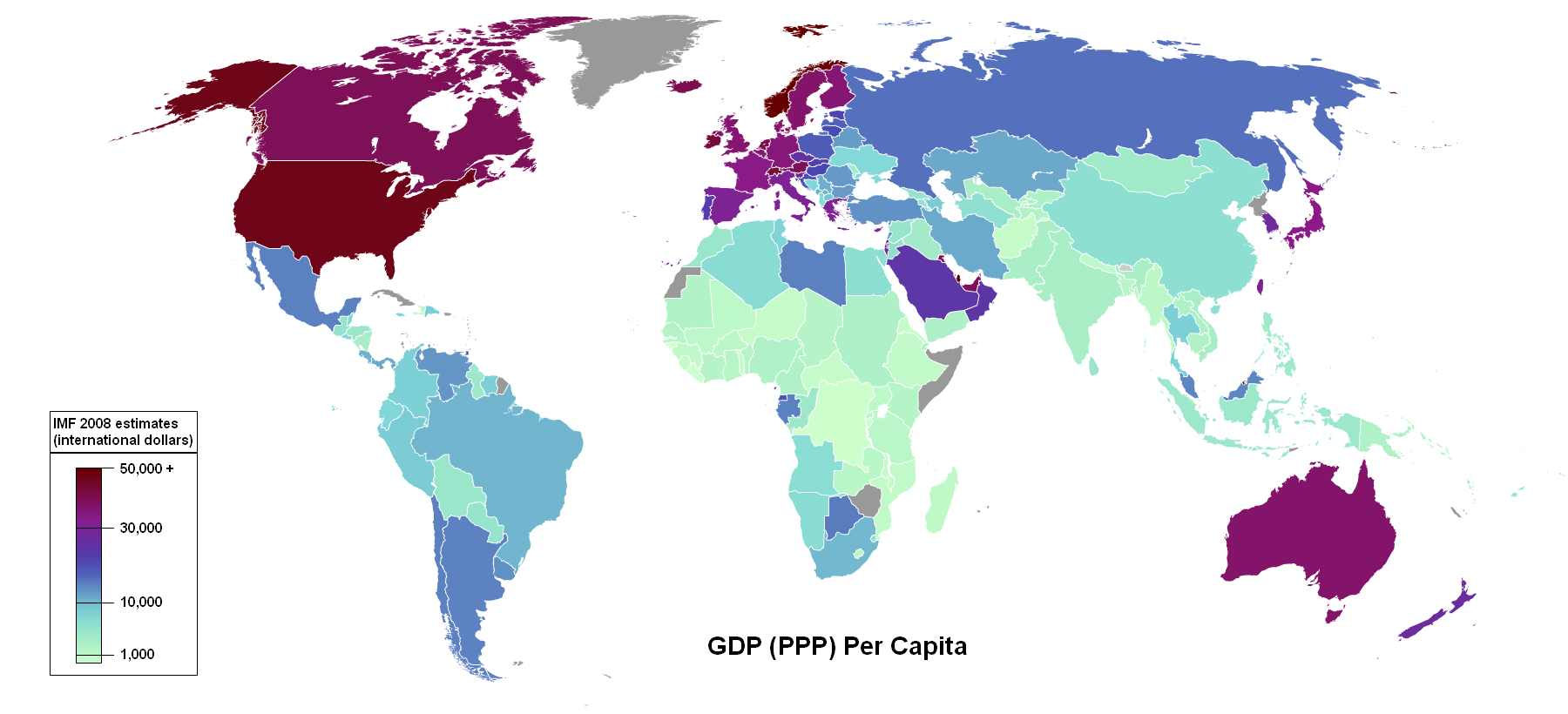
A Comforting Map
As we begin this new election season, let's not let ourselves be distracted by hysteria over the growth of China or the so-called collapse of our economy. Let's remember where all the money actually is.
Tuesday, February 1, 2011
Revolution Number Nile
Egyptian President Hosni Mubarak has pledged not to seek reelection this September. On January 24, this would have been shocking, too-good-to-be-true news for most Egyptians. The fact that many Egyptians view this as too little change, happening too slowly, is proof of how dramatically the political climate in Egypt has been changed by this week of protests.
All the same, Mubarak has given the Egyptian public something to think about. I'm curious to see how many protesters continue to come out into the streets in the days ahead. These protests have essentially shut down the country. Are Egyptians prepared to risk food shortages and a continued frozen economy to try and get Mubarak out on their terms rather than his?
Tuesday, January 4, 2011
Auxiliaries, Citizens, and Mexicans
Political discourse on immigration reform remains remarkably limited and short-sighted. Opponents of the act tend to characterize it as a gross injustice. Bending our nations laws to accommodate illegal aliens cannot, in their view, be justified. Uneducated and illiterate Mexicans have little to contribute to modern American; they will burden our public schools, hospitals, and welfare system while paying minimal taxes. Ultimately, these economic and social arguments veil either racist attitudes towards Hispanics or an acute lack of foresight and political understanding. Laws are meant to be adapted to respond to changing circumstances. With sluggish population growth, a faltering recovery, and massive budget deficits, America could benefit greatly by an influx of new citizens, even if they are generally unskilled and uneducated. It is ironic that many of the same Republicans who so vehemently espouse free trade (e.g. NAFTA) oppose looser immigration policy.
Labels:
Ancient Rome,
DREAM Act,
Immigration,
Jonathan
Friday, December 24, 2010
Realism Not Racism
I believe I may be the only NSTOnian who openly describes himself as a Realist, and one of my favorite bloggers over at Foreign Policy is Stephen Walt. He may not be as BRO as T. Ricks, but intellectually his arguments are very much in line with my views. Here is a good post from him the other day responding to a post by the neo-con Michael Gerson. I think people often hurry to place all conservatives under the same foreign policy camp, but the difference between these two writers clearly shows this is not the case.
Tuesday, December 21, 2010
Divided Government 2.0
This winter's edition of The Economist's annual predictions issue, The World in 2011, is on the shelves. Arianna Huffington's contribution is "The Year of Hope 2.0," an article that appears to be too short for the size of its ideas, whatever they may in fact be. Here, I will only address the supposition that "Hope 1.0," and its accompanying President have failed irredeemably.
Sunday, December 19, 2010
Sources on Sacrifice
For those of you interested in ancient history or archaeology, the following may be relevant to your interests:
New research has tendency to be over-hyped. A recent study of a Carthaginian infant burial site (a Tophet) has refuted the proposition by some scholars that all the infants buried at Tophets were sacrificed (here is the article). Osteological analysis of the remains of infants has shown that 20 percent of those found died before birth, and thus could not have been sacrificed. It seems more likely that Tophets were used as more general burial sites.
However, this does little to refute the general historical evidence for child sacrifice at Carthage. Kleitarchos, Diodorus, the Old Testament, and some inscriptions all support child sacrifice at Carthage. Schwartz, the author of the article, rightly limits his conclusions: "Skeletal Remains from Punic Carthage Do Not Support Systematic Sacrifice of Infants." However, as so often happens, studies limited in scope are taken too far. One article has gone so far as to declare that Schwarts' research refutes "millennia-long claims of mass infant sacrifice in ancient Carthage." This just isn't the case. Nothing says that all of those children buried died of natural causes. Moreover, some sacrifices could have been buried elsewhere. Writers in the media and university have a responsibility to remain skeptical of new claims and opinions. Unfortunately, there is a tendency to blow new research out of proportion and make sweeping claims about the past. Orthodox perspectives should not be quickly dismissed, and new research should not be overstated.
Subscribe to:
Posts (Atom)