Economic sanctions don't always get the best rap. Frustrated Middle East watchers and myriad Obama critics point to Iran as proof that sanctions aren't coercive, but the detractors may have spoken too soon.
FP's The Cable blog (which, incidentally, has impressed me with its coverage of the Syrian chemical weapons story) put up a new piece this Friday on the reputation of Hasan Rouhani, Iran's new president, in the US intelligence community. Former IC officials who met Rouhani during the Reagan administration say he struck them as a genuine moderate.
If they're right, his election could be a first step toward real progress on ending Iran's nuclear weapons ambitions. But the article also mentions another contributing factor: the UN sanctions regime.
Monday, September 23, 2013

Wednesday, September 4, 2013
Russponsibility to Protect
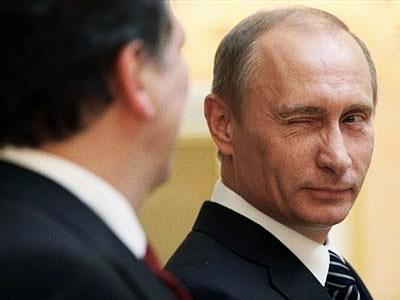
One may well ask, as Jonathan did today: doesn't Putin remember his own 2008 "intervention" in Georgia?
Wednesday, July 17, 2013
Korea Checkpoints #2: The Kaesong Industrial Complex

Tuesday, July 16, 2013
Korea Checkpoints #1

Friday, September 14, 2012
Romney Needs a Russian Reset on Libyan Consulate

Let's compare Mitt Romney's and Russian President Vladimir Putin's responses to the death of Ambassador Chris Stevens and his colleagues.
Here's Mitt:
It's disgraceful that the Obama Administration's first response was not to condemn attacks on our diplomatic missions, but to sympathize with those who waged the attacks.And here's Our #1 Geopolitical Foe:
...there can only be one opinion: we condemn this crime and express our condolences to the families of the victims.
Monday, August 13, 2012
With Ryan, Romney Rolls the Hard Six

Until Friday evening, my thoughts on Mitt Romney's likely running mate were limiteded to my certainty that it would not be Marco Rubio. Romney's whole campaign had been based on making the election a "referendum on Obama," An up-or-down vote on the incumbent President, into which Romney himself barely figured at all.
Ryan and his famed budget wonkiness are a clear departure from that strategy. Combine that with Obama's widening lead in the polls over the past few weeks, and to me the Ryan pick is pretty clearly a Hail Mary. Convinced he was going to lose, Romney changed the conversation. Now, instead of a referendum on Obama, the election will certainly be about the size of government.
Monday, March 19, 2012
Greece's Past and the Debt Crisis
Here is an interesting article I read on Greece's debt crisis. The basic argument is that the Greeks resent their northern European creditors - despite an enormous amount of leniency - because they feel that they have been taken advantage of historically. The author does not present any quantifiable polling data, but his historical examples do offer some food for thought. This is the kind of wedding of history to current events which helps us understand why people can behave so stupidly. It is sometimes difficult to see how the history of Classical Greece, the Byzantine and Ottoman Empires, and the Third Reich can still have an effect on the present.
Wednesday, September 21, 2011
Turkey and Israel are at it again
 |
| Photo credit: The Economist (also, an article worth reading) |
In case you haven’t been following recent developments in the Middle East/North Africa region other than Libya—and let’s face it, it’s my academic guilty pleasure so I can hardly expect everyone to—Turkey and Israel are at it again. The briefest outline goes a little something like this: 9 Turkish citizens are killed as part of an aid flotilla to the West Bank, Turkey demands an apology, Israel refuses to apologize, the UN investigation is leaked which calls the actions of the Israeli commandos unnecessary but also does not call the blockade illegal, Israel still refuses to apologize, Turkey expels the Israeli ambassador, Israeli FM approaches the internationally recognized Kurdish terrorist group the PKK with talk of support, the PKK also demands an apology, Turkish PM visits Cairo, there is an attack on the Israeli embassy in Cairo. With Turkish threats of warship escorts, and Israel just not being cooperative, the U.S. is stuck between a rock and a hard place this week at the UN.
Friday, August 12, 2011
Cameron vs. Twitter?

I am not a big believer in the idea that web-based social media is a revolutionary political tool. My fellow 20-somethings tend to embrace this idea because twitter et al. are so widely used in their social circles. I suspect that those in older demographics jump into social media because they see the 20-somethings doing it and don't want to feel old. But Facebook doesn't change the way people think, or the concerns they have about their political situation. It simply changes the speed at which ideas are exchanged.
Additionally, I have little patience for the claims that the current riots in London are a youth-led political movement in the vein of the Arab Spring. Unlike Tahrir, the Tottenham riots represent the worst rather than the best potential of collective youth activity. The rioters are involved basically in theft and arson, not political activism. If your biggest political grievance is that you don't want to pay market value for a PS3, then you probably have no legitimate political grievances.
However, none of that means I'm OK with David Cameron's recent talk of disrupting UK access to social networks to combat the riots.
Monday, July 18, 2011
Critical Juncture in EU Integration?

Dueling Banjos today in RCW's afternoon edition: a Daily Mail op-ed says the Euro must end, while ex-Eurocrats counter that the Euro could be saved with further EU integration. The authors' biases are obvious enough, but what might be less obvious is that they don't actually disagree with each other.
Both articles present the separation of monetary and fiscal policy as the source of the Eurozone crisis, and they're right. If Greece and the rest of the PIIGS still had national currencies, they could mitigate the problems austerity is giving them through inflation. And if fiscal policy were at least partially elevated to the EU level, redistributive assistance to the PIIGS wouldn't be left to the caprice of national politics in Germany. Monetary integration without fiscal coordination has proved to be a dangerous half measure.
Saturday, April 30, 2011
A Comforting Map
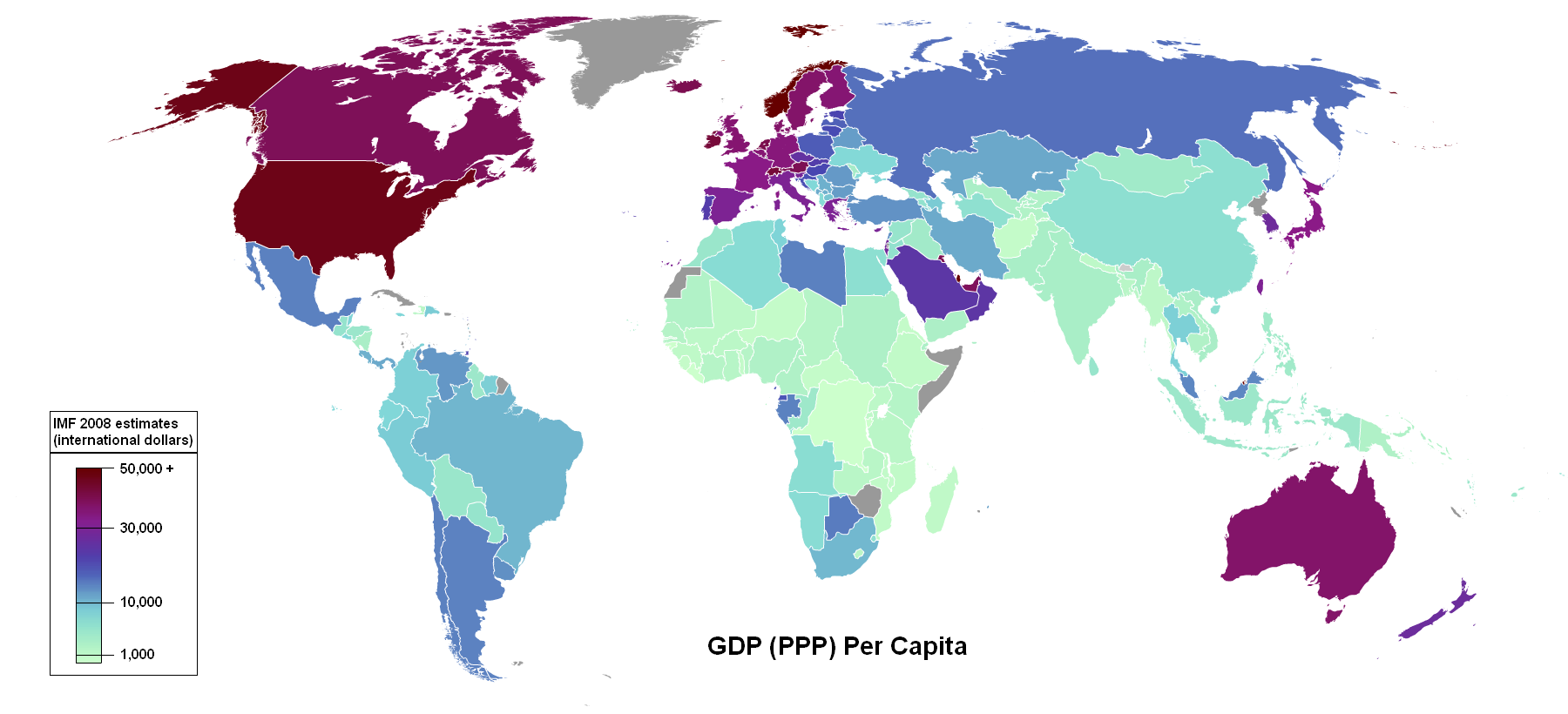
As we begin this new election season, let's not let ourselves be distracted by hysteria over the growth of China or the so-called collapse of our economy. Let's remember where all the money actually is.
Tuesday, February 1, 2011
Revolution Number Nile

Egyptian President Hosni Mubarak has pledged not to seek reelection this September. On January 24, this would have been shocking, too-good-to-be-true news for most Egyptians. The fact that many Egyptians view this as too little change, happening too slowly, is proof of how dramatically the political climate in Egypt has been changed by this week of protests.
All the same, Mubarak has given the Egyptian public something to think about. I'm curious to see how many protesters continue to come out into the streets in the days ahead. These protests have essentially shut down the country. Are Egyptians prepared to risk food shortages and a continued frozen economy to try and get Mubarak out on their terms rather than his?
Tuesday, January 4, 2011
Auxiliaries, Citizens, and Mexicans

Political discourse on immigration reform remains remarkably limited and short-sighted. Opponents of the act tend to characterize it as a gross injustice. Bending our nations laws to accommodate illegal aliens cannot, in their view, be justified. Uneducated and illiterate Mexicans have little to contribute to modern American; they will burden our public schools, hospitals, and welfare system while paying minimal taxes. Ultimately, these economic and social arguments veil either racist attitudes towards Hispanics or an acute lack of foresight and political understanding. Laws are meant to be adapted to respond to changing circumstances. With sluggish population growth, a faltering recovery, and massive budget deficits, America could benefit greatly by an influx of new citizens, even if they are generally unskilled and uneducated. It is ironic that many of the same Republicans who so vehemently espouse free trade (e.g. NAFTA) oppose looser immigration policy.
Friday, December 24, 2010
Realism Not Racism
I believe I may be the only NSTOnian who openly describes himself as a Realist, and one of my favorite bloggers over at Foreign Policy is Stephen Walt. He may not be as BRO as T. Ricks, but intellectually his arguments are very much in line with my views. Here is a good post from him the other day responding to a post by the neo-con Michael Gerson. I think people often hurry to place all conservatives under the same foreign policy camp, but the difference between these two writers clearly shows this is not the case.
Tuesday, December 21, 2010
Divided Government 2.0

This winter's edition of The Economist's annual predictions issue, The World in 2011, is on the shelves. Arianna Huffington's contribution is "The Year of Hope 2.0," an article that appears to be too short for the size of its ideas, whatever they may in fact be. Here, I will only address the supposition that "Hope 1.0," and its accompanying President have failed irredeemably.
Sunday, December 19, 2010
Sources on Sacrifice
For those of you interested in ancient history or archaeology, the following may be relevant to your interests:
New research has tendency to be over-hyped. A recent study of a Carthaginian infant burial site (a Tophet) has refuted the proposition by some scholars that all the infants buried at Tophets were sacrificed (here is the article). Osteological analysis of the remains of infants has shown that 20 percent of those found died before birth, and thus could not have been sacrificed. It seems more likely that Tophets were used as more general burial sites.
However, this does little to refute the general historical evidence for child sacrifice at Carthage. Kleitarchos, Diodorus, the Old Testament, and some inscriptions all support child sacrifice at Carthage. Schwartz, the author of the article, rightly limits his conclusions: "Skeletal Remains from Punic Carthage Do Not Support Systematic Sacrifice of Infants." However, as so often happens, studies limited in scope are taken too far. One article has gone so far as to declare that Schwarts' research refutes "millennia-long claims of mass infant sacrifice in ancient Carthage." This just isn't the case. Nothing says that all of those children buried died of natural causes. Moreover, some sacrifices could have been buried elsewhere. Writers in the media and university have a responsibility to remain skeptical of new claims and opinions. Unfortunately, there is a tendency to blow new research out of proportion and make sweeping claims about the past. Orthodox perspectives should not be quickly dismissed, and new research should not be overstated.
New research has tendency to be over-hyped. A recent study of a Carthaginian infant burial site (a Tophet) has refuted the proposition by some scholars that all the infants buried at Tophets were sacrificed (here is the article). Osteological analysis of the remains of infants has shown that 20 percent of those found died before birth, and thus could not have been sacrificed. It seems more likely that Tophets were used as more general burial sites.
However, this does little to refute the general historical evidence for child sacrifice at Carthage. Kleitarchos, Diodorus, the Old Testament, and some inscriptions all support child sacrifice at Carthage. Schwartz, the author of the article, rightly limits his conclusions: "Skeletal Remains from Punic Carthage Do Not Support Systematic Sacrifice of Infants." However, as so often happens, studies limited in scope are taken too far. One article has gone so far as to declare that Schwarts' research refutes "millennia-long claims of mass infant sacrifice in ancient Carthage." This just isn't the case. Nothing says that all of those children buried died of natural causes. Moreover, some sacrifices could have been buried elsewhere. Writers in the media and university have a responsibility to remain skeptical of new claims and opinions. Unfortunately, there is a tendency to blow new research out of proportion and make sweeping claims about the past. Orthodox perspectives should not be quickly dismissed, and new research should not be overstated.
Monday, December 13, 2010
OH Berlusconi!

This is one of my first posts for a while, so why not post something to make us all smile?
It, honestly, gives me pride to see my second prime minister Silvio Berlusconi, being so candid and not politically correct! (OK so his hilarious quips may not be the most strategic political tactic, but they certainly provide for excellent entertainment!)
His most recent comment was a complement on President Barak Obama's tan.
On another note, it may seem incredible that Berlusconi has remained in power so long with his very controversial commentary on other politicians, the left wing and not to mention his liaisons with teenage girls but, from recent events, his power appears to be tenuous - He will be facing a confidence vote in the upper and the lower house. Although it is thought that he will still retain his majority in the senate, he may not be so lucky in the lower hues with the abandonment of many of his old supporters. Will this mean an early election for Italy? (well it wouldn't be the first time!)
Evangelicals and Academics
Here's an interesting article on Evangelicalism in modern America. I believe that it is indicative of an underlying lack of diversity within the academic community. Conservative Christian academics are a dying breed. As the author acknowledges, most professors, even of religion, are completely unfamiliar with the religious identity of millions of modern Americans. Even the author of the article (Timothy Beal) ascribes to the liberal dogma of academe (notice his description of the Bible as "an accidental book"). Contrary to this article's suggestion, no mere article or book will bridge the fundamental gap between academia and conservative Christianity. If Evangelicals truly want to be understood, they themselves must penetrate the ivory tower of academia. Until underrepresented groups finally gain their own voices in the liberal world of the American university, they will remain strangers and foes of academics.
Monday, November 29, 2010
WikiLeaks continues to be harmful in a different way than it thinks it is

The latest Wikileaks "scandal," a dump of over 250,000 US diplomatic cables and other documents, is alleged by many in the press and assumed by much of the public to be extremely revelatory and shocking. In fact, very, very little, if anything, in the leak, has surprised anyone who's been paying even a minimum of attention to international news over the past 8-12 months.
What in this leak is actually surprising news?
Saturday, November 6, 2010
Is this war in the 21st century?
Would you have every thought that it would be possible to cite Google as your casus belli?
Well, that's not stopping Nicaragua from trying. At least that's what Costa Rica's La Nacion is reporting, calling the border that Google Maps shows an "error." (That's the extent of my Spanish. More like Spanglish.)
Well, that's not stopping Nicaragua from trying. At least that's what Costa Rica's La Nacion is reporting, calling the border that Google Maps shows an "error." (That's the extent of my Spanish. More like Spanglish.)
Subscribe to:
Posts (Atom)